Supervised learning is a type of machine learning in which a model is trained using labeled data, where each input has a known output or target value.
The model learns the relationship between input features (X) and the target/output (Y) and uses this knowledge to predict the output for new, unseen data.
| Feature | ID3 | CART |
| Split criterion | Entropy / Information Gain | Gini impurity (default) |
| Splits | Usually multiway | Binary |
| Classification | Yes | Yes |
| Regression | No | Yes |
sklearn built-in | Not directly as “ID3” | DecisionTreeClassifier |
Steps Involved in Supervised Learning
- Collect Data
Gather a dataset containing input features and their corresponding output labels. - Prepare the Data
Clean the data, handle missing values, remove unnecessary data, and convert categorical data into a suitable format. - Split the Dataset
Divide the data into:- Training data (X)– used to train the model.
- Testing data (y)– used to evaluate the model.
- Select a Model
Choose a suitable supervised learning algorithm, such as:- Linear Regression
- Decision Tree
- K-Nearest Neighbors (KNN)
- Support Vector Machine (SVM)
- Naive Bayes
- Train the Model
Feed the training data to the algorithm so that it learns patterns and relationships between inputs and outputs. - Evaluate the Model
Test the trained model using unseen test data and measure its performance using suitable metrics such as accuracy, precision, recall, or mean squared error. - Tune the Model
Adjust model parameters or features to improve performance and reduce overfitting. - Make Predictions
Use the trained model to predict outputs for new, unseen data.
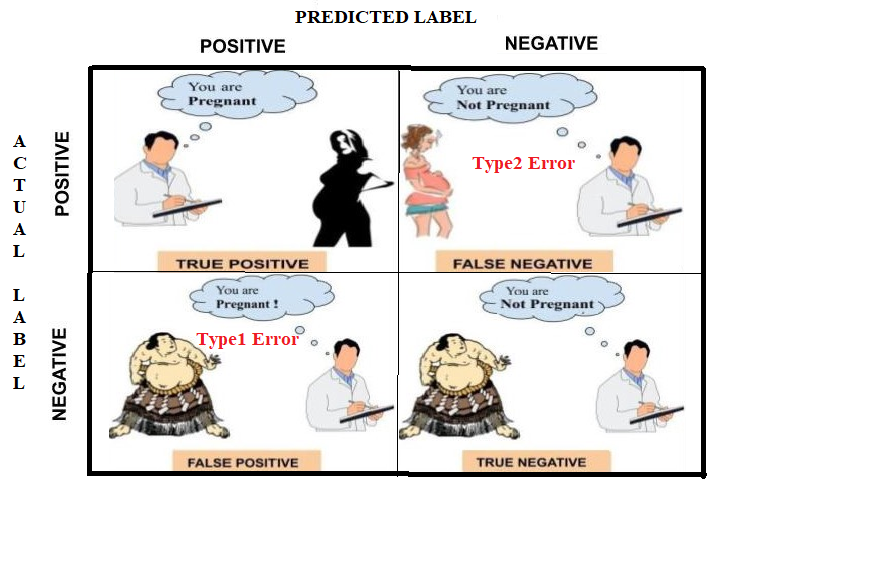
Confusion Matrix